
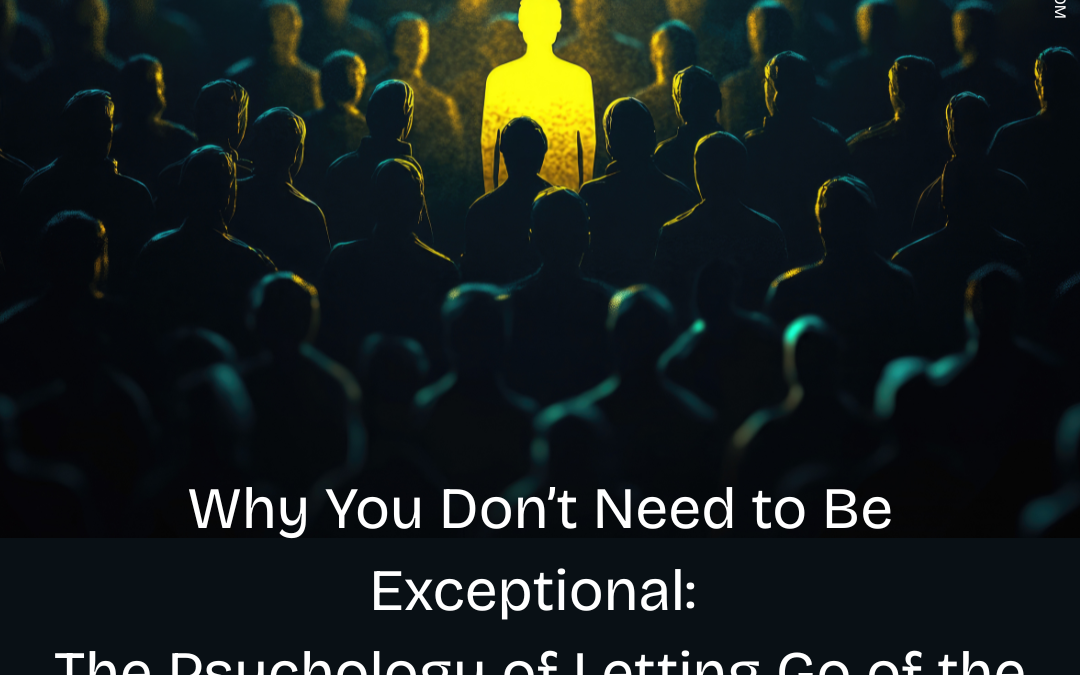
When you work in fields such as mine and those related to it, saying “You Don’t Need to Be Exceptional” is seen as a crime by some. I’ve wanted to write about why we don’t need to be exceptional for some time and today I’ve finally gotten around to it.
The Psychology of Letting Go of the Pressure to Stand Out
In our modern Western world where social media in particular constantly showcases the lives of high achievers, influencers, and prodigies of varying kinds, the pressure to be exceptional can feel overwhelming. So much self-improvement and personal development literature and themes seems to be focused upon a main goal of how to be exceptional. We are often encouraged to stand out, be the best, or leave a mark on the world. The message is clear: ordinary isn’t enough.
Yet, paradoxically, striving to be exceptional can lead to chronic stress, anxiety, and a diminished sense of self-worth. For me and I hope for some of you reading this, it can actually be comforting and liberating to be told: you don’t need to be exceptional to lead a deeply meaningful, satisfying, and valuable life.
Today I’m exploring the psychological science behind why chasing exceptionality can actually be harmful, and how embracing ordinariness can actually be one of the healthiest and most fulfilling choices you make.
The Myth of Exceptionality
From a young age, we are taught that success equals recognition, awards, or influence. Educational systems reward the best grades. Career paths praise high performers. Social media algorithms often elevate the supposedly most exciting lives. But this pursuit of being “special” or “above average” isn’t without cost.
Psychologist Dr. Barry Schwartz, in his book The Paradox of Choice (2004), discusses how the modern emphasis on individual success and distinction leads to increased dissatisfaction. With every new opportunity to excel comes the burden of making the “perfect” choice and the fear of being ordinary.
In the words of author Alain de Botton:
“Anyone who isn’t embarrassed of who they were last year probably isn’t learning enough.”
While this quote encourages growth and is shared regularly;arly by many influencers seeking to drive their followers to be exceptional, it subtly suggests that constant self-improvement is mandatory. But personal growth does not have to lead to being exceptional; it can lead to being more grounded, authentic, and connected to oneself.
The Psychological Toll of Needing to Be Exceptional
A. Perfectionism and Burnout
The desire to be exceptional is often rooted in perfectionism, which has been shown to correlate strongly with anxiety, depression, and burnout (Curran & Hill, 2019). In their large-scale study of over 40,000 university students, Curran and Hill found that perfectionism has significantly increased over the past few decades, particularly socially prescribed perfectionism—the belief that others expect us to be perfect.
This relentless pursuit can create a toxic cycle:
You strive to be the best.
You fall short (as we all do at times).
You internalise failure.
You strive harder, becoming more stressed and less fulfilled.
The myth of exceptionality can turn daily life into a treadmill of never feeling “good enough”.
B. Impostor Syndrome
Even when individuals do achieve above-average success, they often feel like frauds. This is known as impostor syndrome—where people doubt their accomplishments and fear being exposed as a “fake”.
Clance and Imes (1978), who coined the term, found that high-achieving women in particular often attributed their success to luck rather than competence. Today, this phenomenon is known to affect people across all genders and industries. Ironically, those trying hardest to be exceptional are often the least able to internalise their own success.
The Power of Being “Good Enough”
Winnicott’s “Good Enough” Parent and the Case for Being Ordinary
Psychoanalyst Donald Winnicott introduced the concept of the “good enough mother” in the 1950s, a ground-breaking shift away from perfectionism in parenting. Winnicott argued that children do not need perfect parents—they need caregivers who are simply “good enough”: attuned, responsive, and available most of the time.
This concept applies well beyond parenting. Being “good enough” in life, work, or relationships—showing up, being kind, doing your best within limits—can yield far more satisfaction than constant overachievement.
“There is nothing noble in being superior to your fellow man; true nobility is being superior to your former self.” – Ernest Hemingway
Meaning and Fulfilment Come from Connection, Not Status
One of the most robust findings in psychological science is that human connection — not fame, wealth, or achievement — is the strongest predictor of a fulfilling life.
A. The Harvard Study of Adult Development
The longest-running study on happiness and wellbeing, the Harvard Study of Adult Development (started in 1938), has followed hundreds of participants over 80 years. Its central finding?
“The clearest message we get from this 75-year study is this: Good relationships keep us happier and healthier.” – Dr. Robert Waldinger, current study director.
No part of the study concluded that exceptional status, awards, or public recognition were predictive of life satisfaction or longevity.
Rather, those who cultivated deep friendships, maintained strong family ties, and fostered emotional intimacy thrived—even if their lives appeared unremarkable on paper.
B. Self-Determination Theory
Self-Determination Theory (SDT), developed by Deci and Ryan (1985), outlines three basic psychological needs:
Autonomy – feeling in control of your life.
Competence – feeling capable and effective.
Relatedness – feeling connected to others.
SDT emphasises that fulfilling these core needs is more important to well-being than being the best at anything. People report higher life satisfaction when they live in alignment with these values—not when they “stand out”. Self-hypnosis can advance self-determination skills and help with several of the other points on this page, learn more at this page of this college website: Learn Self-Hypnosis Here.
The “Ordinary” Path to Purpose
A. Contribution over Achievement
Studies have shown that having a sense of purpose — feeling that your life matters and contributes to something bigger —predicts physical health, resilience, and happiness (Hill & Turiano, 2014).
Interestingly, purpose is not restricted to high achievers. You can find meaning in:
Being a loving parent or partner
Volunteering in your community
Creating art that no one else sees
Being kind to a stranger
All of these “ordinary” actions contribute to the social fabric and your own well-being. I’ve written on this topic previously in a different way, it has been something of a pet subject of mine, read this article for example: The Beautiful in the Ordinary – And How That Relates to Hypnosis.
B. Quiet Leadership and Everyday Heroes
Leadership researchers (Grant & Parker, 2009) have identified a rising appreciation for “quiet leaders”—those who don’t seek the spotlight, but who support, uplift, and create change in small, steady ways.
These are the teachers, mentors, carers, and neighbours whose impact is felt deeply, even if they never become famous or recognised. Their lives are no less meaningful.
Social Comparison and the Tyranny of “Better”
A. The Comparison Trap
Humans are wired for social comparison, a concept introduced by psychologist Leon Festinger in 1954. However, upward comparison—where we compare ourselves to those we perceive as better off—often fuels dissatisfaction and envy.
Social media has intensified this dramatically. Research by Vogel et al. (2014) found that greater Facebook usage was associated with lower self-esteem and higher depressive symptoms due to upward social comparisons.
For more on this topic, read this article: Stop Comparing Yourself to Others.
B. Reframing Success
To escape this trap, it helps to redefine success on your own terms. What if success meant:
Having time to rest
Feeling secure and loved
Learning something new
Being kind to yourself
This mindset shift is empowering. It moves the goalposts from “being exceptional” to “being fulfilled”.
The Joy of Missing Out (JOMO)
We’ve heard of FOMO—Fear of Missing Out. But JOMO, the Joy of Missing Out, is a growing counter-movement encouraging people to embrace presence, simplicity, and quiet living.
JOMO is the psychological antidote to the hustle culture that equates busyness with worth. It allows us to find pleasure in:
Saying no
Doing less
Being content with enough
Psychologist Dr. Laurie Santos, from Yale University’s course on “The Science of Well-Being”, teaches that happiness often lies not in chasing more, but in appreciating what we already have.
Self-Worth Isn’t Conditional on Achievement
The belief that our value lies in what we achieve is deeply embedded in Western culture. But psychological approaches like Acceptance and Commitment Therapy (ACT) that I teach on my diploma courses encourage people to decouple self-worth from performance.
ACT teaches psychological flexibility: the ability to stay in contact with the present moment, accept internal experiences, and take committed action aligned with your values.
You can feel fear, failure, or shame—and still be worthy. You are enough just as you are.
Embracing Mediocrity as a Radical Act
In his essay The Joy of Being Average, author Mark Manson argues that embracing your own averageness is not defeatist — it’s liberating. It frees you from comparison, shame, and unrealistic expectations. It allows you to focus on what matters: living an authentic life.
In a culture obsessed with being the best, allowing yourself to be average is a revolutionary act of self-kindness.
You Are Enough
You don’t need to be exceptional to live a life full of meaning, love, growth, and joy. In fact, letting go of the pressure to be exceptional may be the very thing that allows you to thrive.
Choose connection over competition. Choose authenticity over perfection. Choose fulfilment over fame.
Because being truly yourself—not better than others—is more than enough.
Have some of themes here resonated with you? Then have a read of these pages:
Would you like a satisfying and meaningful career as a hypnotherapist helping others? Are you a hypnotherapist looking for stimulating and career enhancing continued professional development and advanced studies? Adam Eason’s Anglo European training college.
References:
Clance, P. R., & Imes, S. A. (1978). The imposter phenomenon in high achieving women: Dynamics and therapeutic intervention. Psychotherapy: Theory, Research & Practice, 15(3), 241.
Curran, T., & Hill, A. P. (2019). Perfectionism is increasing over time: A meta-analysis of birth cohort differences from 1989 to 2016. Psychological Bulletin, 145(4), 410.
Deci, E. L., & Ryan, R. M. (1985). Intrinsic motivation and self-determination in human behavior. Springer Science & Business Media.
Festinger, L. (1954). A theory of social comparison processes. Human Relations, 7(2), 117–140.
Grant, A. M., & Parker, S. K. (2009). Redesigning work design theories: The rise of relational and proactive perspectives. Academy of Management Annals, 3(1), 317–375.
Hill, P. L., & Turiano, N. A. (2014). Purpose in life as a predictor of mortality across adulthood. Psychological Science, 25(7), 1482–1486.
Schwartz, B. (2004). The Paradox of Choice: Why More is Less. Harper Perennial.
Vogel, E. A., Rose, J. P., Roberts, L. R., & Eckles, K. (2014). Social comparison, social media, and self-esteem. Psychology of Popular Media Culture, 3(4), 206–222.
Waldinger, R., & Schulz, M. (2023). The Good Life: Lessons from the World’s Longest Scientific Study of Happiness. Simon & Schuster.
Winnicott, D. W. (1953). Transitional objects and transitional phenomena. International Journal of Psycho-Analysis, 34, 89–97.

