
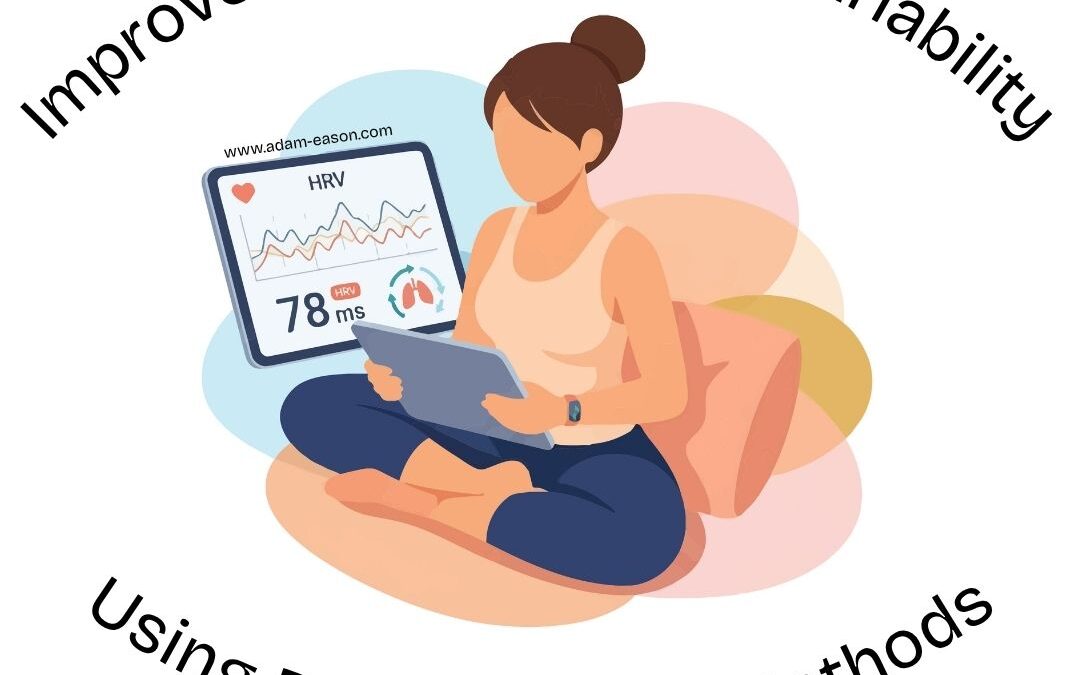
How to improve heart rate variability (HRV) using psychology has become a pet subject of mine in the past year as I have used it to gauge my own recovery and development with an ongoing tough training regimen and busy life. A short while ago, I recorded a video about how to improve heart rate variability using psychology that you can watch here, but today I wanted to share an article with you on that topic.
Heart rate variability (HRV) has emerged as one of the most powerful physiological indicators of mental and emotional well-being. Once largely confined to clinical and research settings, HRV is now widely discussed in psychology, neuroscience, and even performance coaching. Yet despite its growing popularity, many misunderstand what HRV actually represents and – more importantly – how to improve it using purely psychological means.
Most advice on HRV focuses on physical interventions such as exercise, sleep optimisation, or nutrition. While these are undeniably important, they are not my own field of expertise and they overlook a crucial truth: HRV is also deeply influenced by the mind. Psychological processes – our thoughts, emotions, attention, and perceptions – play a direct role in shaping autonomic nervous system activity, and therefore HRV.
Here today then, I’m exploring HRV through a psychological lens. We will examine what HRV is, why it matters for both mental and physical health, and – most importantly – how you can improve it using evidence-based psychological strategies that can be applied in everyday life.
What Is Heart Rate Variability (HRV)?
Heart rate variability refers to the variation in time between successive heartbeats. Rather than beating like a metronome, a healthy heart shows subtle fluctuations in the intervals between beats. These variations are not random; they reflect the dynamic interplay between different regulatory systems in the body.
At the centre of this process is the autonomic nervous system (ANS), which consists of two primary branches:
- The sympathetic nervous system (SNS), associated with “fight or flight” responses
- The parasympathetic nervous system (PNS), associated with “rest and digest” states
HRV is essentially a measure of the balance and flexibility between these two systems. Higher HRV generally indicates a well-regulated system capable of adapting to stress and environmental demands. Lower HRV, by contrast, suggests rigidity and reduced adaptability.
From a psychological perspective, HRV represents the body’s capacity to respond to emotional and cognitive challenges. It is not just a cardiovascular metric—it is a window into the brain–body connection.
As one review notes, a “complex and constantly changing heart rate is an indicator of healthy regulatory systems that can effectively adapt to sudden environmental and psychological challenges.”
Why HRV Matters: The Psychological and Health Benefits
1. Emotional Regulation
Higher HRV is consistently associated with better emotional regulation. Individuals with higher HRV tend to recover more quickly from stress, regulate negative emotions more effectively, and demonstrate greater psychological resilience.
Conversely, low HRV has been linked with anxiety, depression, and emotional dysregulation.
2. Stress Resilience
HRV reflects how efficiently the body can transition between states of activation and recovery. A higher HRV indicates greater flexibility—your system can “gear up” when needed and “wind down” efficiently afterwards.
Lower HRV is often associated with chronic stress, where the system becomes stuck in a prolonged sympathetic (stress) state.
3. Cognitive Function
Emerging research suggests that HRV is linked to executive functioning, attention, and decision-making. This aligns with theories such as the neurovisceral integration model, which proposes that HRV reflects the functional integrity of brain networks involved in self-regulation.
4. Physical Health
HRV is not just about mental well-being—it is also a predictor of physical health outcomes. Reduced HRV has been associated with cardiovascular disease, inflammation, and poorer overall health.
5. Psychotherapy Outcomes
Recent research suggests HRV may even predict responsiveness to therapy and improvements in mental health, reinforcing its role as a marker of psychological flexibility and recovery.
The Psychological Foundations of HRV
To understand how psychological interventions can improve HRV, we need to appreciate one key principle:
HRV is not just influenced by what happens to you—it is influenced by how you interpret and respond to what happens to you.
Your thoughts, beliefs, attention patterns, and emotional responses all shape autonomic activity. This means that psychological interventions can directly influence HRV by altering:
- Perception of stress
- Emotional responses
- Cognitive appraisals
- Attentional focus
- Self-regulation capacity
In short, improving HRV psychologically is about training the brain to regulate the body more effectively.
Psychological Strategies to Improve HRV
Below are evidence-based psychological methods that can enhance HRV. These strategies focus exclusively on mental processes, rather than physical interventions.
1. Cognitive Reappraisal: Changing Your Interpretation of Stress
Cognitive reappraisal involves reframing how you interpret stressful situations.
Instead of viewing stress as harmful, you reinterpret it as a challenge or opportunity. This shift reduces sympathetic activation and promotes parasympathetic balance.
Research shows that individuals who habitually use reappraisal exhibit better emotional regulation and physiological resilience.
Practical Application
- When faced with stress, ask: “What else could this mean?”
- Reframe pressure as preparation or growth
- View physiological arousal as readiness, not threat
2. Mindfulness and Present-Moment Awareness
Mindfulness involves paying attention to the present moment in a non-judgemental way. It reduces rumination and emotional reactivity, both of which are linked to lower HRV.
Mindfulness has been repeatedly shown to increase parasympathetic activity and improve HRV.
Practical Application
- Focus on sensory experiences (sounds, sights, bodily sensations)
- Notice thoughts without engaging with them
- Practice brief “check-ins” throughout the day
Even short mindfulness practices can positively influence HRV by calming the nervous system.
3. Emotional Labelling (Affect Labelling)
Simply putting emotions into words can reduce their intensity. This process—known as affect labelling—has been shown to decrease amygdala activation and increase regulatory control.
This improved regulation is reflected in better autonomic balance and potentially higher HRV.
Practical Application
- Name your emotional state: “I feel anxious”
- Be specific: “I feel frustrated and uncertain”
- Avoid suppression—acknowledge rather than ignore
4. Self-Compassion and Internal Dialogue
Harsh self-criticism activates threat systems in the brain, increasing sympathetic activation and reducing HRV.
By contrast, self-compassion activates soothing systems associated with parasympathetic activity. You can read more on this topic by reading this article: How to Develop More Self-Compassion.
Practical Application
- Replace self-criticism with supportive language
- Ask: “What would I say to a friend in this situation?”
- Practise compassionate self-talk during stress
5. Attentional Control Training
Where you direct your attention influences your physiological state.
Focusing on threats, worries, or negative outcomes sustains stress responses. Training attention towards neutral or positive stimuli can reduce this effect.
Practical Application
- Use attentional “anchors” (e.g., breath, sounds)
- Redirect attention when caught in worry loops
- Limit repetitive negative thinking
6. Psychological Detachment from Stress
Psychological detachment refers to mentally “switching off” from stressors, particularly outside of work.
Chronic cognitive engagement with stress (e.g., rumination) maintains low HRV.
Practical Application
- Create mental boundaries between work and rest
- Use rituals to signal “switching off”
- Engage fully in non-work activities
Self-hypnosis can help greatly with stress reduction, learn more at this page of my college website: Learn Self-Hypnosis Here.
7. Values-Based Living
Acting in alignment with personal values reduces internal conflict and psychological stress.
Acceptance and Commitment Therapy (ACT) emphasises values-based behaviour as a way to enhance psychological flexibility—closely linked to HRV.
Practical Application
- Identify core values (e.g., growth, connection, integrity)
- Make daily decisions aligned with these values
- Focus on meaningful action rather than avoidance
8. Visualisation and Mental Imagery
Guided imagery can evoke calm states and activate parasympathetic responses.
The brain often responds to imagined scenarios similarly to real ones, making this a powerful tool for influencing HRV.
Practical Application
- Visualise calm, safe environments
- Imagine successful coping in stressful situations
- Engage all senses in the imagery
9. Gratitude and Positive Emotional Cultivation
Positive emotions broaden attention and build psychological resources. They are associated with increased vagal tone and improved HRV.
Practical Application
- Keep a daily gratitude journal
- Reflect on positive experiences
- Savour moments of enjoyment
10. Acceptance and Letting Go of Control
Attempts to control or suppress internal experiences often backfire, increasing stress and reducing HRV.
Acceptance-based approaches reduce this struggle and promote physiological regulation.
Practical Application
- Allow thoughts and feelings without resistance
- Practise “observing” rather than reacting
- Focus on what you can control—your actions
11. Social Connection and Psychological Safety
Perceived social support enhances parasympathetic activity and HRV.
The feeling of safety—rather than actual physical safety—is key.
Practical Application
- Engage in meaningful conversations
- Foster supportive relationships
- Prioritise connection over isolation
Integrating These Strategies into Daily Life
The key to improving HRV psychologically is consistency rather than intensity. Small, repeated shifts in thinking and attention can lead to meaningful physiological changes over time.
A simple daily structure might include:
- Morning: brief mindfulness or intention setting
- Midday: cognitive reappraisal during stress
- Evening: reflection or gratitude practice
Over time, these practices train the nervous system to become more flexible, adaptive, and resilient.
Final Thoughts
Heart rate variability is more than a physiological metric—it is a reflection of your capacity to adapt, regulate, and thrive in the face of life’s demands.
Improving HRV does not require complex technology or extreme interventions. By changing how you think, feel, and respond to the world, you can directly influence your nervous system and enhance your overall well-being.
In essence, improving HRV psychologically is about cultivating flexibility—of mind, emotion, and behaviour. And in doing so, you are not just improving a number—you are improving your ability to live well.
Have some of themes about the psychology of how to improve heart rate variability resonated with you? Then have a read of these pages:
Would you like a satisfying and meaningful career as a hypnotherapist helping others? Are you a hypnotherapist looking for stimulating and career enhancing continued professional development and advanced studies? Adam Eason’s Anglo European training college.
References:
Pham, T., Lau, Z. J., Chen, S. H. A., & Makowski, D. (2021). Heart rate variability in psychology: A review of HRV indices and an analysis tutorial. Sensors, 21(12), 3998. https://doi.org/10.3390/s21123998
Gregoire, S., et al. (2023). Heart rate variability and mental health: A review of psychophysiological mechanisms. BMC Psychology.
Silva, L. E. V., et al. (2021). Autonomic nervous system and heart rate variability: A review. Frontiers in Physiology.
Thayer, J. F., & Lane, R. D. (2000). A model of neurovisceral integration in emotion regulation and dysregulation. Journal of Affective Disorders, 61(3), 201–216.
Gross, J. J. (2015). Emotion regulation: Current status and future prospects. Psychological Inquiry, 26(1), 1–26.
Neff, K. D. (2003). Self-compassion: An alternative conceptualisation of a healthy attitude toward oneself. Self and Identity, 2(2), 85–101.
Kabat-Zinn, J. (2003). Mindfulness-based interventions in context: Past, present, and future. Clinical Psychology: Science and Practice, 10(2), 144–156.
Hayes, S. C., Strosahl, K., & Wilson, K. G. (2011). Acceptance and Commitment Therapy: The Process and Practice of Mindful Change. Guilford Press.
Fredrickson, B. L. (2001). The role of positive emotions in positive psychology. American Psychologist, 56(3), 218–226.

