
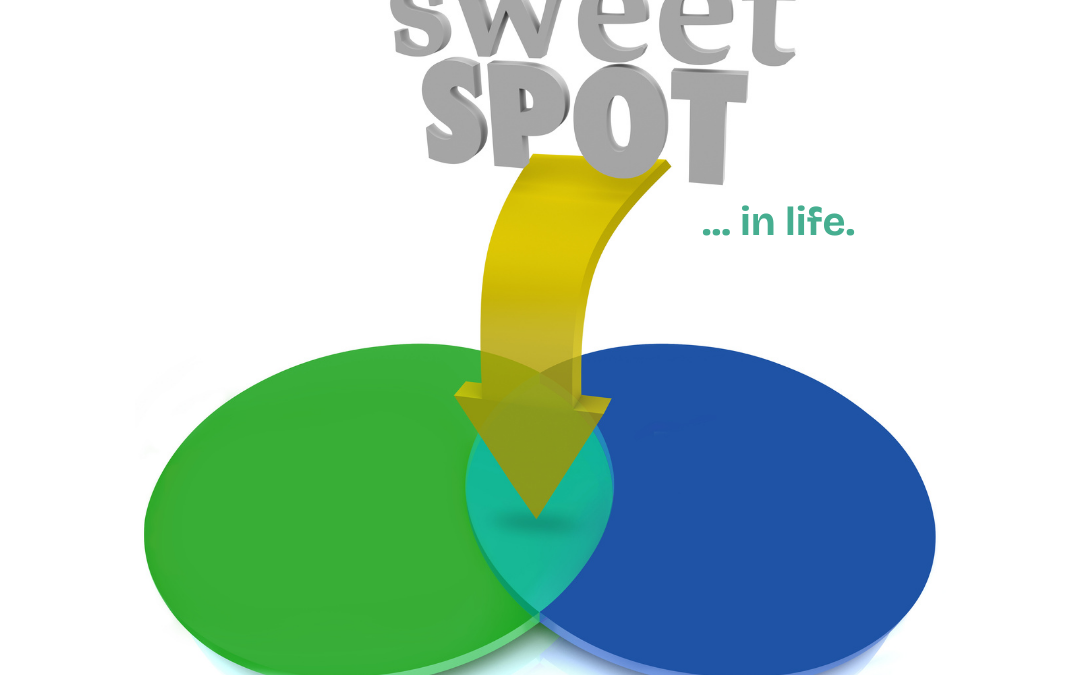
How do you find your sweet spot?
Often, when I start a hypnosis session with a student or client, I ask them to position themselves in such a way that the crown of their head is pointing up towards the ceiling and that their head is in a position whereby it will not droop forward or fall backwards, it is just balanced in that sweet spot of comfort for the session ahead.
I can remember watching village cricket games with my Granddad who used to umpire when I was a boy and watching an opening batsman hit a long drive straight back past the bowler for a six. Chatting about it after the game, my Granddad spoke of the ball being struck in the sweet spot of the bat which made a great sound and was the place where the most effective contact was made.
Today, I’m writing about how you can find your sweet pot. In the often demanding pace of modern living, many of us can feel overwhelmed, lost, or unfulfilled. The quest for happiness and balance can appear elusive; maybe it even leads to stress and mental strain. However, one way to a happier, more content existence can lie in identifying and nurturing your “sweet spot” in life? Here today, I’m exploring what it means to find your sweet spot and am offering up some scientifically-backed strategies that can help you achieve a more balanced and fulfilling life.
What is Your Sweet Spot?
When I say ‘find your sweet spot’, what do I actually mean? The term “sweet spot” broadly refers to the ideal state of balance in various aspects of life—work, relationships, self-care, and personal growth. Essentially, it’s a place where your passions, skills, and values intersect, providing a sense of fulfilment and contentment. Finding this sweet spot correlates strongly with improved mental health, emotional regulation, and overall happiness.
Psychologist Roy Baumeister states, “Meaning comes from the integration of self and world.” Understanding where you fit within the complex tapestry of life can help guide you toward your sweet spot, and can lead to creating a meaningful sense of purpose and satisfaction.
The Psychological and Emotional Benefits of Finding Your Sweet Spot
Scientific literature indicates numerous psychological and emotional benefits tied to discovering one’s sweet spot. Firstly, when you find your sweet spot, it may mean engaging in activities that fulfil our passions leads to intrinsic motivation—doing something for its inherent value rather than for external rewards. A study by Ryan and Deci (2000) highlights that intrinsic motivation is linked to greater well-being, vitality, and wellness.
When individuals align their lives with their true selves—identifying their strengths, weaknesses, values, and passions—they are more likely to experience higher levels of self-esteem and reduced anxiety (Bowers, 2019). Importantly, having a clear understanding of your sweet spot can lead to a stronger sense of identity and purpose.
1. Self-Reflection and Awareness
The first step when aiming to find your sweet spot is to dedicate time for self-reflection. Set aside a regular period each week to engage in introspective practices such as journaling or mindfulness meditation. This helps explore your values, passions, and what makes you feel fulfilled. Research by Brown et al. (2015) emphasises that mindfulness practices not only enhance self-awareness but can also reduce symptoms of anxiety and depression.
2. Clarify Your Values
Your values are foundational to discovering your sweet spot. Write down what matters most to you—whether it’s family, career success, community service, or personal growth. When your actions align with your core values, research suggests you are more likely to experience harmony and satisfaction in life (Schwartz, 2012).
Read these articles about How to Live Life With a Sense of Purpose and How to Live a More Meaningful Life for more on this topic.
3. Set Realistic Goals
Setting SMART (Specific, Measurable, Achievable, Relevant, Time-bound) goals can steer you towards your sweet spot. These goals should reflect your values and passions. A sense of achievement fosters motivation, propelling you further along the path of fulfilment (Locke & Latham, 2002).
4. Seek Out Activities that Bring Joy
Engage in hobbies or activities that spark joy and resonate with your interests. Whether it’s painting, hiking, or volunteering, research shows that pleasurable activities activate the brain’s reward system, enhancing emotional well-being (Kreuger et al., 2020).
5. Foster Connections with Like-Minded People
Surround yourself with individuals who uplift and inspire you. Positive social connections are vital for mental health and can significantly contribute to how you find your sweet spot. A study by Holt-Lunstad et al. (2010) highlights that strong social relationships can increase longevity and improve overall mental health.
You may find these articles about Friendship and It’s Importance and this video about Why You Need to Start Building Your Social Interaction for more on this topic.
6. Embrace a Growth Mindset
Adopting a growth mindset—believing that abilities can be developed through dedication and hard work—allows you to embrace challenges and learn from criticism. Carol Dweck’s (2006) research demonstrates that those with a growth mindset are more resilient and better equipped to cope with life’s obstacles. Read this article about How to Develop a Growth Mindset for more on this topic.
7. Practice Gratitude
Incorporating gratitude practices into your daily routine can enhance your emotional well-being. Research published by Emmons and McCullough (2003) suggests that regularly expressing gratitude can lead to greater happiness and reduced feelings of depression, helping you to focus on what truly matters in your life.
8. Prioritise Well-being and Self-Care
Make it a priority to care for your physical and mental health. Engage in regular exercise, eat nutritious foods, and ensure you get quality sleep. According to the World Health Organization (WHO), physical health is directly linked to mental health, emphasising the importance of holistic well-being.
Self-hypnosis is a great tool to help with self-care and some of the exercises outlined here in this article, you can go and Learn Self-Hypnosis Here for free.
9. Seek Professional Guidance
Sometimes, you may need help and guidance to find your sweet spot and you may benefit from an external perspective. Consulting a mental health professional can provide valuable insights and strategies tailored to your unique situation. Cognitive-behavioural therapy (CBT), for instance, has been shown to effectively enhance mental health and well-being (Hofmann et al., 2012).
10. Be Open to Change
Life is dynamic, and your sweet spot may evolve over time. Remain open to new experiences and allow yourself the flexibility to adapt. Embracing change can lead to unexpected opportunities that deepen your sense of fulfilment.
Conclusion
Finding your sweet spot in life is not a one-time event; rather, it’s an ongoing journey of self-discovery and growth. By focusing on self-reflection, aligning your actions with your values, and fostering connections, you can navigate life’s complexities with greater ease and joy. Remember, you have the power to actively shape your life, leading you to a place of balance, happiness, and improved mental health.
As the author and cultural critic bell hooks said, “Life-transforming ideas have always come to me through relationships – with my own heart, with my body, with my mind, with others.” So take the first step today—explore, engage, and discover your sweet spot.
References
- Baumeister, R. F. (2016). “Meaning comes from the integration of self and world.” Psychological Inquiry.
- Bowers, D. (2019). “Finding Self through Passion: Understanding the Link.” Journal of Positive Psychology.
- Brown, K. W., Ryan, R. M., & Creswell, J. D. (2015). “Mindfulness: Theoretical foundations and evidence for its salutary effects.” Psychological Science in the Public Interest.
- Dweck, C. S. (2006). “Mindset: The New Psychology of Success.” New York: Ballantine Books.
- Emmons, R. A., & McCullough, M. E. (2003). “Counting Blessings Versus Burdens: An Experimental Investigation of Gratitude and Subjective Well-Being in Daily Life.” Journal of Personality and Social Psychology.
- Holt-Lunstad, J., Smith, T. B., & Layton, J. B. (2010). “Social Relationships and Mortality Risk: A Meta-analytic Review.” PLoS Medicine.
- Hofmann, S. G., Asnaani, A., Vonk, I. J. J., Sawyer, A. T., & Fang, A. (2012). “The Efficacy of Cognitive Behavioral Therapy: A Meta-Analysis.” Cognitive Therapy and Research.
- Kreuger, A. B., & Schkade, D. A. (2020). “The reliability of subjective well-being measures.” National Bureau of Economic Research.
- Locke, E. A., & Latham, G. P. (2002). “Building a practically useful theory of goal setting and task motivation: A 35-year odyssey.” American Psychologist.
- Ryan, R. M., & Deci, E. L. (2000). “Intrinsic and Extrinsic Motivations: Classic Definitions and New Directions.” Contemporary Educational Psychology.
- Schwartz, S. H. (2012). “An Overview of the Schwartz Value Survey.” In: Advances in Psychology.
Have some of themes here resonated with you? Then have a read of these pages:
Would you like a satisfying and meaningful career as a hypnotherapist helping others? Are you a hypnotherapist looking for stimulating and career enhancing continued professional development and advanced studies? Adam Eason’s Anglo European training college.
Likewise, if you’d like to learn more about self-hypnosis, understand the evidence based principles of it from a scientific perspective and learn how to apply it to many areas of your life while having fun and in a safe environment and have the opportunity to test everything you learn, then come and join me for my one day seminar which does all that and more, have a read here: The Science of Self-Hypnosis Seminar. Alternatively, go grab a copy of my Science of self-hypnosis book.


