
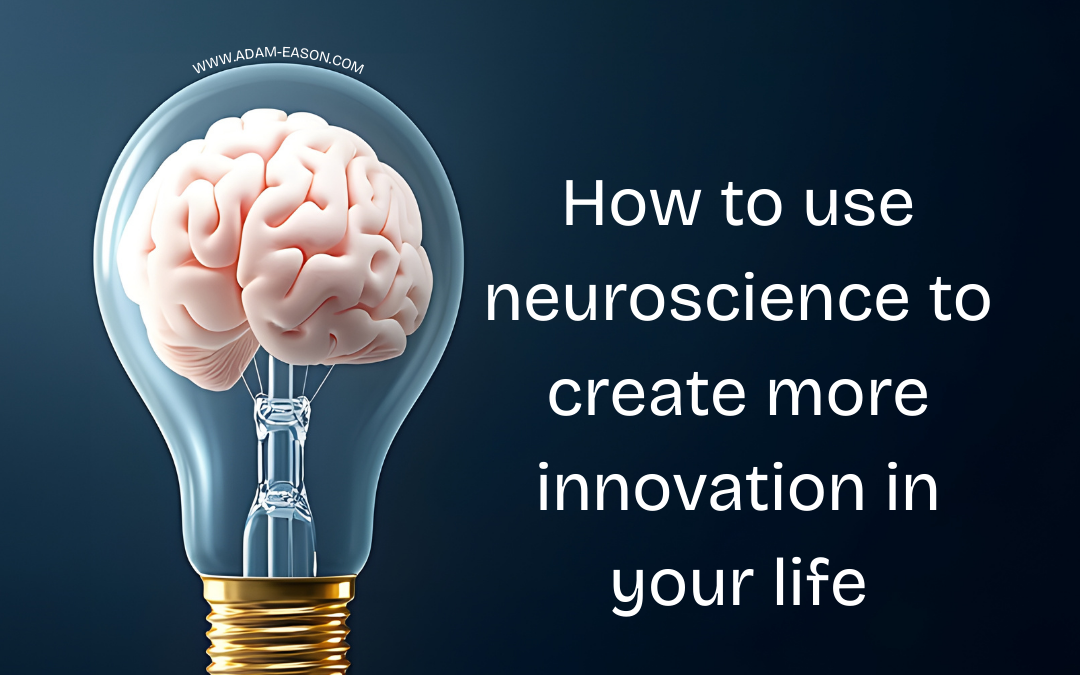
This article today is all about how to create more innovation, according to neuroscience. To be clear, innovation is the ability to generate novel, useful ideas and ideally then turn them into action — is not necessarily some magical, innate gift bestowed upon just a few “creative types”. Rather, it can be seen as a set of cognitive skills and brain states that can be learned, practised and developed. Modern neuroscience offers insight into this and gives us practical, evidence-based levers you can pull to think more creatively, solve problems differently and feel better as a result.
Here today then, I’m going to explain why certain practices help (short, accessible neuroscience), offer up evidence for each one, and offer up some actionable steps you can implement right away. I also want to highlight the psychological and wellbeing benefits of becoming more innovative, because it can be really good for us to do so.
“Creativity is just connecting things.” — Steve Jobs
“Every act of creation is first an act of destruction.” — Pablo Picasso
I really like these two quotes. Both of which capture a couple of truths that neuroscience supports: creative thinking stitches together distant ideas, and it often requires letting go of old patterns. Below are practical, science-backed ways to encourage those processes.
What neuroscience says about creativity and innovation:
Rather than one single “creative centre”, creativity emerges from dynamic interactions between large-scale brain networks:
Default Mode Network (DMN) — active during mind-wandering, imagination and free association; it supplies novel ideas and mental simulations. Research shows that stronger connectivity in the DMN is linked with higher creative idea generation.
You can read more about this here in this article: Unlocking the Power of the Brain’s Default Mode Network.
Executive Control Network (including lateral prefrontal cortex) — supports focused attention, evaluation and the selection of useful ideas from the DMN’s imaginative output. Effective creativity depends on the interplay between spontaneous idea generation (DMN) and selective control.
Dopaminergic systems — neurotransmitters like dopamine modulate novelty-seeking, cognitive flexibility and reward sensitivity; individual differences in dopamine function relate to differences in creative cognition.
Other supports — sleep (sleep-dependent memory reorganisation can foster insight), physical activity (boosts divergent thinking), positive mood and varied sensory input all influence creative performance.
Knowing this, we can employ a range of practical interventions that nudge those brain systems in creative directions…
Practical, Neuroscience-Backed Ways To Create More Innovation:
Alternate focused work with deliberate mind-wandering (incubation)
Why it works: The DMN generates wide, associative thinking when you let the mind roam; the executive network then evaluates and refines the promising ideas. Alternating focused work with periods of unfocused thought (walking, chores, doodling) encourages this interplay. Studies show that creative problem solving benefits from such incubation.
How to do it: Work in 45–90 minute focused blocks, then take 10–20 minute “diffuse mode” breaks (walk, make tea, tidy).
During the break, avoid social media or email — do something mildly engaging but undemanding.
Use sleep strategically to consolidate and restructure problems
Why it works: Sleep, especially slow-wave sleep followed by REM, helps restructure memory traces and can precipitate sudden insight. Classic experiments showed more than double the chance of gaining insight after sleep versus staying awake.
How to do it: Learn or work on a problem in the evening, then sleep on it. Keep a notepad beside the bed to capture any overnight insights.
If you’re stuck, try a short nap after an initial study session — naps can also aid creative restructuring.
More on this topic here: The Reasons for Regular Napping, and the Science to Support It.
Self-hypnosis can help with napping and with a number of other approaches in this article, learn more at this page of my college website: Learn Self-Hypnosis Here.
Move your body: short aerobic sessions to boost divergent thinking
Why it works: Acute aerobic exercise reliably enhances the fluency and flexibility of idea generation (divergent thinking). Regular physical activity also shows a medium-sized positive effect on creative ideation in meta-analyses. Exercise modulates arousal, mood and neurochemical systems that support cognitive flexibility.
How to do it: If you’re facing a creative block, go for a 15–30 minute brisk walk, jog, or cycle before brainstorming.
Make regular exercise part of your routine — chronic activity builds a creative “baseline”.
Design your environment to invite novelty and affordances
Why it works: Novel sensory input and varied experiences increase associative richness — the raw material for creative combinations. The brain notices novelty and releases neuromodulators (e.g. dopamine) that make exploration more rewarding.
How to do it: Rearrange your workspace occasionally, add plants, change background music or try working from a café or library. Carry a “curiosity notebook” to jot down odd facts, images or overheard phrases to feed future associations.
Use constraints deliberately to force new combinations
Why it works: Paradoxically, constraints can increase creativity by forcing you to recombine elements in novel ways — the executive network must find new solutions under limits. Many creative breakthroughs come from constrained problems (e.g. “how can I say this in 20 words?”). This aligns with neuroscience showing that problem framing influences which networks are engaged.
How to do it: Give yourself limits (time, words, materials) when ideating. Try a “one-sentence solution” exercise.
Use random-input constraints (pick a random object and force an association).
Practise “divergent + convergent” sessions
Why it works: Creativity requires both quantity of ideas (divergent thinking) and quality selection (convergent thinking). Structuring sessions to separate the two avoids premature criticism and lets DMN and control networks do their jobs sequentially. Neuroscience supports this separation of generative and evaluative processes.
How to do it:
Phase 1: 10–20 minutes rapid idea generation (no judgement).
Break: 5–10 minutes (walk).
Phase 2: 20 minutes evaluate, combine and select best ideas.
Harness mood: use positive affect to broaden thinking
Why it works: Positive moods increase cognitive breadth and associative thinking (making it easier to connect distant concepts). Dopamine and reward circuitry linked to positive affect also facilitate exploration. This is supported by psych and neuroscience literature linking mood and creativity.
How to do it: Do a small mood-boosting ritual before ideation: listen to uplifting music, recall a micro-victory, or spend two minutes on a gratitude list. Avoid pressure and fear of judgement during the generative phase.
Practice deliberate play and improvisation
Why it works: Play activates exploratory behaviours, tolerance for error and novel recombination. From a neural perspective, play loosens rigid cognitive routines and increases DMN–control network communication that supports creative risk taking.
How to do it:
Try improvisation exercises (for writing, drawing or conversation), “Yes, and…” games, or playful constraints.
Schedule short weekly play sessions where outcome doesn’t matter.
Read this article for more on this topic: How and Why You Need To Be More Playful and Childlike.
Build habits that broaden semantic networks (read widely, cross-train)
Why it works: Creativity often depends on connecting ideas from different domains. Neuroscience findings (predicting creative ability from brain connectivity) imply that richer, more diverse semantic networks supply better raw material for novel combinations.
How to do it: Read outside your field for 20 minutes a day. Join groups or courses in unrelated areas (art, coding, gardening).
Train cognitive flexibility via targeted exercises
Why it works: Cognitive flexibility — the ability to shift mental sets and perspectives — is a core component of innovative thinking and is linked to frontal dopamine systems. Training tasks that require switching perspectives can strengthen these skills.
How to do it: Try alternate uses tasks (how many uses for a brick?), perspective-taking exercises, or puzzles that force re-framing. Aim for short, regular practice rather than occasional marathon sessions.
Use rewards and novelty intelligently (dopamine nudges)
Why it works: Dopamine doesn’t create ideas directly, but it motivates exploration, increases attention to novel cues and supports cognitive flexibility. Small, intermittent rewards and novelty can boost creative exploration—without turning creativity into mere performance chasing.
How to do it: Give yourself micro-rewards for exploration (five minutes of a preferred activity after a brainstorming sprint).
Introduce novelty deliberately — new routes to work, new tools, fresh stimuli.
Collaborate with cognitive diversity in mind
Why it works: Diverse teams bring different mental models and associative networks; neuroscience and organisational research show that interacting with people who think differently increases the chance of novel combinations. Networked brain studies show individual creative abilities relate to how brain networks integrate; analogously, groups that integrate perspectives produce richer idea spaces.
How to do it: Mix people from different disciplines, ages and backgrounds in brainstorming. Use structured methods (round-robin, silent idea generation) to avoid fixation on dominant voices.
Reduce chronic stress and manage acute pressure
Why it works: Chronic stress narrows attention, impairs cognitive flexibility and biases toward habitual responses. Neural circuits for control and exploration are dysregulated under sustained stress, making innovation harder. Creating low-threat spaces and stress-management routines supports creative thinking.
How to do it: Create “safe” brainstorming rules (no immediate criticism). Use brief breathing practices or progressive muscle relaxation before ideation sessions.
Keep a “creative archive” and practice recombination
Why it works: Creativity is often recombination — pairing distant stored concepts. By saving interesting fragments (images, quotes, sketches), you increase the pool from which your brain can draw during DMN-driven association. This approach is consistent with evidence that richer associative networks support more original ideas.
How to do it: Keep a digital or physical idea book and review it monthly to force new recombinations.
Use index cards or a simple note-app tagged by theme.
Psychological and wellbeing benefits of becoming more innovative:
Beyond problem-solving, cultivating innovation has measurable wellbeing payoffs…
Improved subjective wellbeing: Experimental and survey studies find that engaging in creative activity boosts subjective wellbeing and positive affect; there’s evidence of a reciprocal relationship — creativity fosters wellbeing, and wellbeing supports creativity.
Meaning and flow: Creative engagement produces feelings of mastery and flow, which are linked to higher life satisfaction and lower stress. The “flow” state itself is associated with immersive focus and intrinsic reward.
Cognitive resilience: Regular creative practice builds flexible thinking and cognitive reserves that can help when facing complex life or work problems. Longitudinal and cross-sectional studies suggest creative engagement supports mental health across the lifespan.
You see, overall, becoming more innovative is not only useful for ideas — it can make you happier, more engaged and more mentally resilient.
Two short, practical 30-day experiments:
If you want to test these ideas, try one of these month-long experiments.
Experiment A — The Incubation & Movement Plan
Daily: 45 minutes focused creative work; 15 minute brisk walk immediately afterwards.
Sleep: prioritise 7–8 hours; attempt a short nap after an afternoon creative session twice weekly.
Weekly: a 30-minute “curiosity read” from an unrelated field.
Experiment B — The Play & Prototype Plan
Daily: 10 minutes of playful improvisation (drawing, writing or audio).
Twice weekly: a 20-minute divergent session (generate ideas) followed by a 20-minute convergent session the next day.
Keep an idea notebook and build one rapid prototype per week.
Both experiments combine multiple neuroscience levers: DMN incubation, sleep consolidation, exercise-driven flexibility, and rapid feedback.
Pitfalls and practical cautions:
Don’t confuse busyness with creativity. Long hours without incubation, play or novelty reduce creative returns. Structure deliberate pauses.
Avoid forced “creativity” under high evaluation threat. The brain’s exploration systems down-regulate when under acute social threat; psychological safety matters.
Individual differences exist. Dopamine and personality traits (e.g. openness) influence how certain strategies work; experiment to find what suits you.
Innovation is not an ethereal trait: it’s a set of brain-supported processes you can learn to cultivate. Start with one small habit — a 15-minute walk before brainstorming, a “no-critique” idea sprint, a night of meaningful sleep after learning a new problem — and build from the results. Keep a simple log of which techniques increase idea quantity, novelty and your sense of enjoyment. Over weeks, the small neural nudges add up.
“You can’t use up creativity. The more you use, the more you have.” — Maya Angelou.
Have some of themes here resonated with you? Then have a read of these pages:
Would you like a satisfying and meaningful career as a hypnotherapist helping others? Are you a hypnotherapist looking for stimulating and career enhancing continued professional development and advanced studies? Adam Eason’s Anglo European training college.
References:
Acar, S., et al. (2021). Creativity and Well-being: A Meta-analysis. Journal of Organisational Behavior
Aga, K. A., & co-authors (2021). The effect of acute aerobic exercise on divergent and convergent thinking: A meta-analysis and review.
Beaty, R. E., Benedek, M., Wilkins, R., Jauk, E., Fink, A., Silvia, P., … & Kaufman, S. B. (2014). Creativity and the default network: A functional connectivity analysis of the creative brain at rest. Neuropsychologia, 64, 92–98. doi:10.1016/j.neuropsychologia.2014.09.019.
Beaty, R. E., Kenett, Y. N., Christensen, A. P., Rosenberg, M. D., Benedek, M., Chen, Q., … & Silvia, P. J. (2018). Robust prediction of individual creative ability from brain functional connectivity. Proceedings of the National Academy of Sciences, 115(5), 1087–1092. doi:10.1073/pnas.1713532115.
Beaty, R. E., Benedek, M., Silvia, P. J., & Schacter, D. L. (2017). Creativity, self-generated thought, and the brain’s default network: A review. In: The Cambridge Handbook of the Neuroscience of Creativity
Fancourt, D., Barnett, K. S., & others (2024). How the arts heal: a review of the neural mechanisms by which creative activity promotes wellbeing. Frontiers in Behavioral Neuroscience.
Käckenmester, W., & colleagues (2019). Openness to experience predicts dopamine effects on divergent thinking.
Rominger, C., & co-authors (2022). Acute and chronic physical activity increases creative ideation performance: A meta-analysis.
Tan, C. Y., & co-authors (2021). Being creative makes you happier: The positive effect of creativity on subjective well-being.
Wagner, U., Gais, S., Haider, H., Verleger, R., & Born, J. (2004). Sleep inspires insight. Nature, 427, 352–355. doi:10.1038/nature02223.
Zabelina, D. L., & Robinson, M. D. (2016). Dopamine and the creative mind: Individual differences in dopamine function and creative cognition. Frontiers in Psychology (review). (See: Zabelina & Robinson, 2016).

